
Treating Facet Joint Syndrome (Vertebral Joint Arthritis) and Back Pain in Düsseldorf
Facet joint syndrome, also known as facet syndrome or vertebral joint osteoarthritis, is a condition of the joints between the vertebral bodies. Alongside disc damage, facet joint syndrome is probably one of the most common causes of back pain.
The facet joints connect two neighbouring vertebrae with each other from behind. They are arranged in pairs, which means there is a left and a right facet joint in each case, and they consist of a joint capsule, a thick layer of cartilage and numerous nerves.
Although the facet joints are largely unknown as connection points of the spine, they play a very large role for the back, since they carry up to a fifth of the weight that bears down on the spine.
The main cause of facet joint syndrome is degenerative damage to the vertebral joints, in other words damage caused by wear. Depending on which facet joints are affected, facet joint syndrome in Düsseldorf is divided into:
- Cervical facet joint syndrome (cervical spine)
- Thoracic facet joint syndrome (thoracic spine)
- Lumbar facet joint syndrome (lumbar spine)
Because the facet joints in the area of the lumbar spine are subject to the greatest load, lumbar facet joint syndrome occurs considerably more often than the cervical or thoracic form.
Answers solely from the contents of this website. Anonymous, no diagnosis.

Symptoms of facet joint syndrome
The main symptom of facet joint syndrome is pain, which occurs predominantly when stretching or bending backwards. Because the facet joints are permeated by a great many small nerves, pain frequently radiates in a pseudoradicular pattern. This means that the pain radiates into the hip and legs. Further possible symptoms of facet joint syndrome are:
- Deep-seated back pain that becomes stronger under load or over the course of the day
- Muskelverspannungen
- Back pain that becomes stronger when leaning back
- Pain when raising one leg while lying down
- A feeling of stiffness in the lumbar spine in the morning
Taken together, the symptoms of facet joint syndrome can lead to restrictions in mobility and quality of life.

Facet joint syndrome: the treatment
Once the diagnosis of facet joint syndrome has been established in Düsseldorf, various treatment options are available. Because facet joint syndrome is a consequence of wear that cannot be fully reversed, treatment is primarily about relieving or eliminating the pain.
Your orthopaedic specialist in Düsseldorf will first try to use conservative treatment. Alongside targeted physiotherapy or taking anti-inflammatory tablets, it is above all injections placed directly at the vertebral joints that have the greatest short-term effect. This is referred to as facet infiltration or injection, in which a mixture of local anaesthetic and cortisone is injected into the painful vertebral joints.
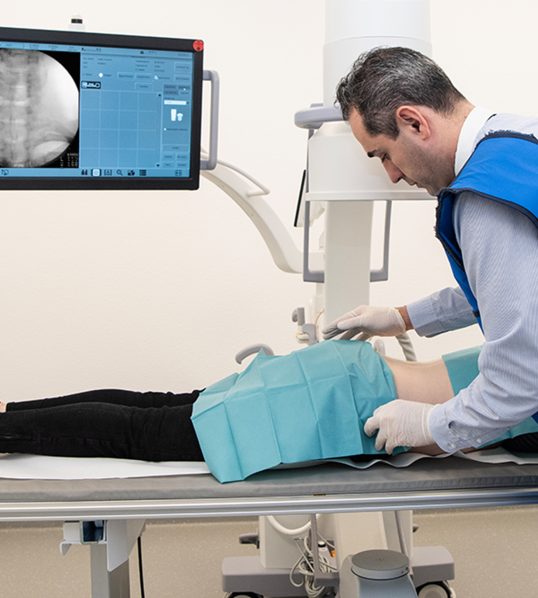
Facettendenervation
If a conservative approach achieves no lasting success, there is also the option of what is known as facet denervation. Here the nerve responsible for transmitting the pain is switched off for a period of time by heat (thermotherapy) or cold (cryotherapy). This effect lasts for up to about two years.
Facet joint syndrome frequently occurs together with other spinal damage and should therefore always be considered as a cause of serious back pain. We will be glad to advise you personally about the treatment options for facet joint syndrome and the associated back pain in Düsseldorf.

Efficient and modern treatment methods for calcific shoulder tendinitis

Competent orthopaedic specialists in Düsseldorf – several practices and a high success rate
Frequently Asked Questions: Facet Joint Syndrome
Is facet joint syndrome curable?
Facet joint syndrome is generally not completely curable, but the symptoms can be relieved with suitable treatment.
Which sport is suitable with facet joint syndrome?
Suitable sports for people with facet joint syndrome are often swimming, cycling, aqua aerobics and gentle strength training under the guidance of a specialist.
How does inflammation of a facet joint arise?
Inflammation of a facet joint can arise through injury, overuse, wear or degenerative changes of the spine.
What helps with lumbar facet joint syndrome?
Treatment of lumbar facet joint syndrome can include physiotherapy, pain medication, injections, exercise therapy and alternative therapies.
Which medicines are used for facet joint syndrome?
Painkillers such as non-steroidal anti-inflammatory drugs (NSAIDs), muscle relaxants and, in some cases, short-term opioids can be used to relieve pain.
How long does inflammation of a facet joint last?
The duration of inflammation of a facet joint can vary and depends on the individual situation. As a rule, inflammation can subside within a few weeks to months.
When is surgery needed for facet joint osteoarthritis?
Surgery may be considered for facet joint osteoarthritis when conservative treatment methods are not sufficient and the symptoms are severely limiting. The decision to operate is taken by the treating doctor and depends on the severity of the condition.
Does health insurance cover treatment for facet joint syndrome?
Examination, imaging, physiotherapy, pain medication and diagnostic and therapeutic facet joint injections with a clear indication are covered by statutory health insurance. Individual procedures such as thermocoagulation are handled differently by different insurers. We clarify this for you in Düsseldorf in advance.
How long does treatment of facet joint syndrome take?
After a facet joint injection, pain relief often sets in within a few days and lasts weeks to months. Accompanying physiotherapy usually runs over six to twelve weeks. As this is an arthritis of the vertebral joints, treatment is designed for the long term.
Which exercises help with facet joint syndrome?
Exercises to straighten the lumbar spine, stretching the hip flexors and strengthening the deep abdominal and back muscles relieve the facet joints. A strong hollow back and overextension increase the symptoms and should be avoided. Have the programme guided by a physiotherapist.
More treatments for Spine Surgery
Complaints rarely come alone. We also offer these treatments from the same area in Düsseldorf.