
Hammertoe and Claw Toe Treatment in Düsseldorf
Digitus malleus - misalignment of the lesser toes
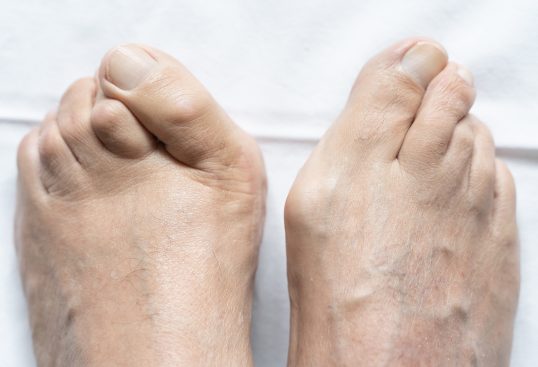
A hammertoe, also written hammer toe, is a toe that is permanently bent at the middle joint. In a claw toe the toe additionally curls downwards at the end joint.
Claw toes or hammer toes, in Latin digitus malleus, are a misalignment of the lesser toes that can lead over time to a reduction in quality of life. These toes look similar, but they differ in their form: while a claw toe is overextended at the base joint and bent at the middle and end joints, a hammer toe shows bending above all at the middle joint. At first these misalignments are often painless, but the constant pressure inside the shoe frequently produces corns and pressure points that can be very painful. Statistically, women are affected more often than men.
Treatment of hammer toe and claw toe in Düsseldorf depends on the severity of the misalignment and on the individual complaints. At early stages, conservative measures such as orthopaedic shoe insoles, toe correction aids, padding or targeted foot exercises can help relieve the misalignment of the lesser toes and counteract any worsening. With advanced digitus malleus, a surgical procedure can also be worthwhile in certain cases in order to correct the position of the toes permanently and reduce pain. Early diagnosis and individually tailored treatment are decisive in preserving mobility and lastingly improving quality of life.
Answers solely from the contents of this website. Anonymous, no diagnosis.
Causes of claw toes and hammer toes
Alongside a genetic predisposition, existing splayed, fallen or pronated feet also come into consideration as a cause of this diagnosis. Occasionally the cause also lies in a hallux valgus, a bending of the big toe towards the lesser toes.
By far the most common cause, however, is years of wearing shoes that are too tight with a high heel. This makes it clear why women are more often affected than men.
Symptoms of claw toes or hammer toes
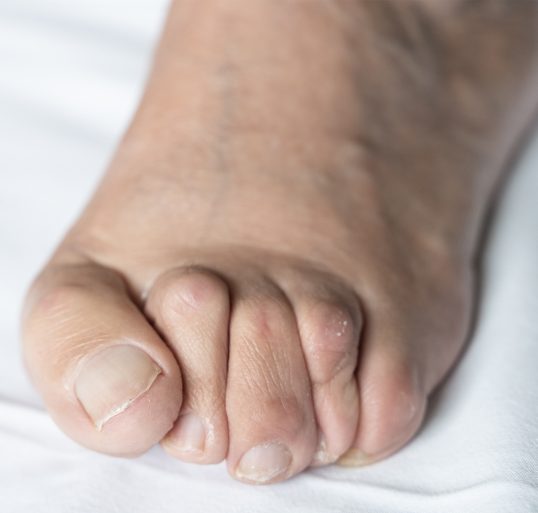
The appearance of claw toes and hammer toes is very characteristic and allows the doctor to establish this condition by visual diagnosis alone. While the hammer toe is bent only at the end joint, the claw toe is overextended at the base joint and bent at the middle and end joints. As a result it no longer has contact with the ground.
An additional X-ray can confirm the diagnosis. The presence of possible changes through wear or osteoarthritis can also be identified in this way.

The treatment of claw toes and hammer toes
Treatment of claw toes and hammer toes in Düsseldorf is definitely worthwhile, since over time the ever-decreasing space inside footwear produces pressure points and corns, which are known to be extremely painful. At a mild to moderate stage, conservative treatment with suitable orthopaedic aids such as insoles and splints, known as orthoses, should be carried out first.
If the stage is advanced or stiffening has already occurred, surgery is unavoidable. Here a transfer of the long extensor tendons is achieved and bony parts of the middle and end segments are removed.
The surgical procedure can be carried out as day surgery and is free of risk. After about 4 weeks the patient can walk normally and is permanently free of the misalignment of their toes.
So that an advanced stage does not develop in the first place if claw toes or hammer toes are suspected, or if that stage has already been reached, we will be very glad to advise you in a personal consultation, because with us you are in the hands of experienced foot surgeons.

Efficient and modern treatment methods for calcific shoulder tendinitis

Competent orthopaedic specialists in Düsseldorf – several practices and a high success rate
Frequently Asked Questions: Claw Toe and Hammer Toe
How do you get hammer toes straight again?
Hammer toes can be treated by various measures, including exercises to strengthen the foot and toe muscles, wearing suitable shoes and shoe insoles, and physiotherapy. In some cases surgical correction may be required.
Can claw toes recede?
Similar to hammer toes, claw toes can be treated by conservative measures such as physiotherapy exercises, suitable footwear and shoe insoles. If these measures bring no success, however, and pain or mobility problems persist, surgery may be necessary.
What is the difference between a hammer toe and a claw toe?
Hammer toes and claw toes are both deformities affecting the toes, but in different ways. With a hammer toe the middle joint of the toe is bent, which gives the toe a hammer-like shape. A claw toe, by contrast, is bent at both joints, which results in a claw-like shape.
What does a claw toe look like?
A claw toe is bent at both joints, so that the toe takes on a claw-like shape. This deformity can occur in all toes, but most frequently affects the smaller toes.
What can be done about a claw toe?
Treatment of claw toes can involve conservative measures such as wearing suitable footwear, special insoles, splints or padding, as well as physiotherapy exercises to strengthen the muscles. If these measures bring no success, surgery may be necessary.
What can be done about a hammer toe?
Shoe insoles, special padding, physiotherapy exercises and wearing suitable shoes can all contribute to the treatment of a hammer toe. If these conservative measures are not sufficient, surgical correction may be necessary.
Is hammer toe surgery painful?
Every operation can involve a certain amount of pain, both during the procedure and in the recovery phase. Painkillers are generally used for relief, however. The pain after hammer toe surgery is usually well manageable and subsides within a few days or weeks.
Which insoles for claw toes?
Orthopaedic insoles can help with claw toes by improving the distribution of pressure inside the shoe and thereby increasing comfort. The insoles should be individually fitted in order to achieve an optimal effect. An orthopaedic specialist or podiatrist can recommend the best type of insole for your particular case.
Does health insurance cover treatment for claw toes and hammer toes?
Examination, X-ray, prescribed insoles, orthoses and medically necessary correction are covered by statutory health insurance. Purely cosmetic procedures are not covered. We check your entitlement and tell you the cost in Düsseldorf in advance.
How long does recovery take after the operation?
The procedure is usually carried out as day surgery. After about four weeks most patients can walk normally again. Residual swelling in the forefoot can persist for some weeks but does subside.
Which exercises help with claw toes and hammer toes?
Toe exercises such as gripping a towel with the toes, spreading them and stretching the toe extensors keep the joints mobile. Padding and toe orthoses additionally relieve the pressure points. At an early stage this can often slow the progression.
More treatments for Foot | Ankle
Complaints rarely come alone. We also offer these treatments from the same area in Düsseldorf.