
Impingement syndrome of the shoulder – diagnosis and treatment in Düsseldorf
Treatment of impingement syndrome with advanced techniques for optimal results.
Shoulder pain is now present in a great many people and has therefore developed into a widespread condition. The most common condition of the shoulder is what is known as impingement syndrome.
People who frequently carry out overhead work in their profession, such as painters, or athletes who practise an arm-intensive sport such as handball, could sooner or later be affected by impingement syndrome. But other people who move heavy loads with their arms over many years also develop impingement syndrome at some point.
Answers solely from the contents of this website. Anonymous, no diagnosis.
Symptoms of impingement syndrome
Symptoms of impingement syndrome can be pain in the shoulder that intensifies when raising the arm or during movements above head height. Pain at night can occur, which makes sleeping on the affected side difficult. Those affected can also feel restricted freedom of movement and a feeling of stiffness in the shoulder. In advanced cases permanent pain and muscle loss are possible.
If you notice such symptoms in yourself, impingement syndrome could be the cause. At our practice in Düsseldorf we specialise in such complaints and can offer you professional help. Do not hesitate to come and see us; we are here to help you.

Causes of shoulder impingement syndrome
Various causes are responsible for the development of impingement syndrome. Between the head of the upper arm and the shoulder roof there is already a certain narrowness anatomically, which is intensified by wear and constant irritation of the tendons. The tendons and the bursa lying beneath the shoulder roof become compressed. This puts the already narrow gliding space out of action, and there is even a danger of a tendon tear if the irritation of the shoulder joint persists.

Treatment of impingement syndrome / shoulder impingement at your orthopaedic specialist in Düsseldorf
The chances of healing this condition are high, particularly with early treatment. After a thorough examination of your shoulder by your Düsseldorf orthopaedic specialist with X-ray, ultrasound and magnetic resonance imaging, various effective treatment options are available. These include medication, physiotherapy and advanced techniques such as shockwave therapy and high-energy induction therapy. In certain cases arthroscopy can also be worthwhile.
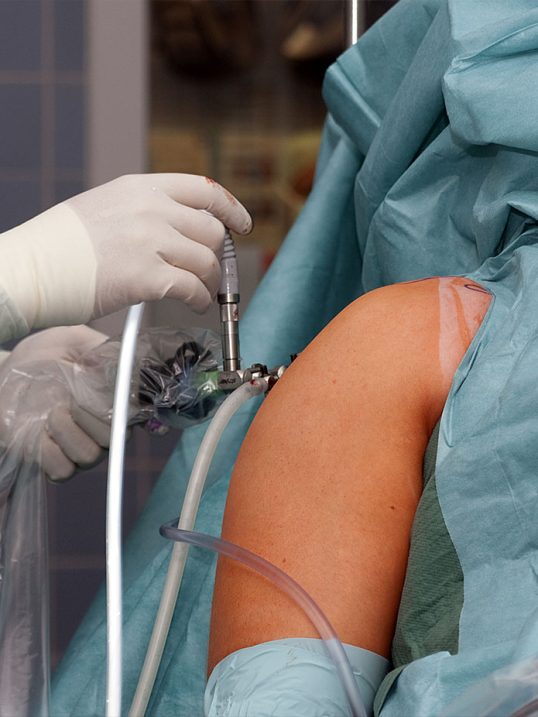
Arthroscopic treatment (joint endoscopy)
If impingement syndrome has reached an advanced stage or bony changes in the form of bone spurs occur, surgery may become necessary. In such cases we routinely carry out a minimally invasive arthroscopy, a method with which we have a great deal of experience.
Only two to three small incisions are required for the procedure. Through the first we introduce a small camera, and with the others we widen the space beneath the shoulder roof. This is achieved by removing the thickened and inflamed bursa and grinding away excess bony structures. Over the following weeks a new, healthy gliding layer forms and the shoulder joint becomes pain-free again.
Thanks to our experience and routine performance, this shoulder operation is very successful and involves little risk. It can be carried out as day surgery. After the procedure it is important to begin gentle physiotherapy from the first day. This is continued over several weeks and serves to strengthen the muscles and restore the natural mobility of the shoulder joint.
Let us treat you with modern methods at our orthopaedic practice in Düsseldorf.
We are experts in the treatment of shoulder impingement syndrome. The diagnosis and treatment of impingement syndrome should always be carried out by an experienced specialist. At our practice too we are geared specifically towards patients with impingement syndrome in Düsseldorf, with a great deal of experience.

Efficient and modern treatment methods for calcific shoulder tendinitis

Competent orthopaedic specialists in Düsseldorf – several practices and a high success rate
Frequently Asked Questions: Impingement Syndrome
How long does it take for impingement syndrome to go away?
The healing time of impingement syndrome is individual and varies. It can take a few weeks to months. Starting treatment early can shorten the healing process considerably, however. It is always advisable to consult an orthopaedic specialist as quickly as possible when symptoms appear.
Which medicines are used for impingement syndrome?
In treating impingement syndrome, anti-inflammatory medicines such as non-steroidal anti-inflammatory drugs (NSAIDs) can be prescribed in order to reduce pain and inflammation. Occasionally, corticosteroid injections can also be administered into the affected shoulder joint in order to treat inflammation specifically. The precise choice of medicine depends on the individual situation and the recommendations of the treating doctor. It is important that you always discuss taking medication with your doctor in order to receive the treatment best suited to you.
Which medicines are used for a compression syndrome?
With a compression syndrome (for example carpal tunnel syndrome or cubital tunnel syndrome), medication does not target the cause (the narrowing) but rather the relief of pain and inflammation. The actual cause is often treated by rest, physiotherapy or, if necessary, surgery.
What happens if impingement syndrome is not treated?
If impingement syndrome remains untreated, the symptoms can worsen over time and lead to considerable restriction. The persistent friction and compression of tendons and soft tissue in the shoulder can lead to chronic pain, inflammation and a deterioration of mobility. In some cases progressive damage to the shoulder structures such as tendon tears or cartilage wear can occur. Through early diagnosis and appropriate treatment, potential complications can be avoided and a better long-term prognosis achieved. It is therefore advisable to seek medical advice when impingement syndrome is suspected and to pursue appropriate treatment.
Which exercises help with impingement?
Special physiotherapy exercises aimed at strength and flexibility can be helpful with impingement syndrome. These include rotation exercises, shoulder circles and stretching exercises. It is important, however, to carry out these exercises under professional guidance in order to avoid worsening the symptoms.
Is impingement syndrome curable?
Yes, impingement syndrome is generally curable. We use a combination of medication, physiotherapy and specific shoulder exercises to relieve the symptoms. Where needed we also use advanced treatment methods such as shockwave therapy, arthroscopy (joint endoscopy) and high-energy induction therapy. The prospects of healing depend on several factors, including the severity of the syndrome and the individual response to treatment. It is therefore important to seek professional advice early in order to draw up the optimal treatment plan.
Which exercises should be avoided with impingement syndrome?
With impingement syndrome, certain exercises should be avoided that place additional strain on the shoulder and could worsen the symptoms. These include exercises with excessive shoulder rotation, movements carried out overhead or lifting heavy weights above the head. Exercises that place strong pressure on the shoulder should also be avoided, such as bench press or shoulder press with heavy weights. It is important to take individual limitations into account and to seek advice from a qualified physiotherapist or orthopaedic specialist in order to develop an individually adapted exercise programme that trains the shoulder gently and safely.
Which massage is suitable with impingement syndrome?
With impingement syndrome a targeted massage can help relax the muscles and improve circulation. A gentle and careful massage of the affected shoulder area can contribute to relieving tension and pain. Massage techniques such as cross-friction, trigger point massage or myofascial release techniques can be used in order to release adhesions in the tissue and improve the mobility of the shoulder. It is advisable to consult an experienced masseur or physiotherapist who has knowledge of impingement syndrome and adapts the massage accordingly, in order to avoid possible damage or deterioration.
Where does impingement syndrome come from?
Impingement syndrome can be caused by various factors, including anatomical characteristics and repeated overhead movements. These can narrow the space between the upper arm and the shoulder roof and lead to irritation. Injuries, age-related changes or unstable shoulder conditions can also play a role. Risk factors include sports with overhead movements, poor posture or muscle weakness. An accurate diagnosis by an orthopaedic specialist helps determine the causes and start suitable treatment.
Where does the shoulder hurt?
Impingement syndrome typically causes pain in the shoulder, which can sometimes extend into the upper arm and neck. Movements that raise the arm above shoulder height in particular can intensify the pain. It can be described as dull, aching or stabbing and can become worse under pressure on the shoulder. With persistent shoulder pain you should always consult a medical professional in order to obtain an accurate diagnosis and suitable treatment.
Does health insurance cover treatment for impingement syndrome?
Statutory health insurance covers medically necessary diagnosis and treatment of impingement syndrome, including physiotherapy and any required arthroscopy. Individual supplementary procedures such as focused shockwave therapy or induction therapy are private services. We discuss the cost openly with you in Düsseldorf before treatment begins.
More treatments for Shoulder | Arm | Hand
Complaints rarely come alone. We also offer these treatments from the same area in Düsseldorf.