
Rotator cuff tears and ruptures: causes and treatment in Düsseldorf
The rotator cuff is a group of muscles and tendons in the shoulder. They start at the shoulder blade and surround the upper part of the arm. The task of the rotator cuff is to stabilise the shoulder joint and to hold the head of the upper arm bone in the socket of the shoulder blade.
The rotator cuff in the shoulder is placed under heavy demand over the course of life, which can lead to wear. When one or more tendons of the rotator cuff tear, this is a rotator cuff rupture or a rotator cuff tear. This is a common shoulder problem that requires special attention. At our specialist centre in Düsseldorf we have the necessary expertise to recognise such injuries early and treat them effectively.
Answers solely from the contents of this website. Anonymous, no diagnosis.

Causes of a rotator cuff tear
The rotator cuff tear is among the most common injuries of the shoulder and can be caused both by accident and by wear. A tear of the rotator cuff often occurs through a fall onto the outstretched arm, an attempt to break a fall or through the sudden lifting of a heavy object.
Even more common are degenerative rotator cuff tears. Here the tendons are already damaged by processes of wear, through which they lose stability over the course of life and are therefore more susceptible to a tear.
Symptome einer Rotatorenmanschettenruptur
A rotator cuff rupture causes different complaints depending on its extent and cause. As a rule, load-dependent and position-dependent pain occurs, which frequently appears at night when lying on the affected side.
Pain on the outer side of the upper arm, pain when raising the arm sideways or the onset of numbness after certain movements of the arm (pseudoparalysis) are also among the possible symptoms of a rotator cuff rupture.
Small tears of the rotator cuff, by contrast, can initially remain free of complaints. With wear-related tears the pain sometimes increases continuously over a longer period, so that a rotator cuff tear is not immediately suspected.
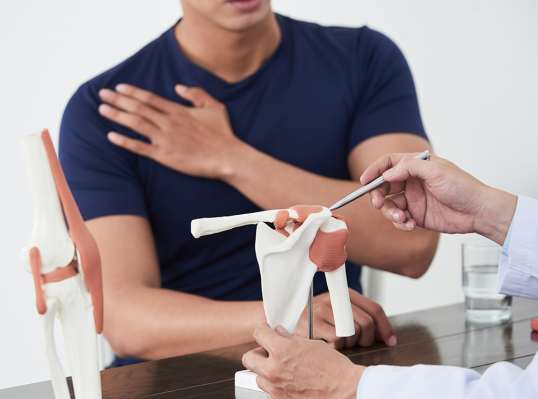
Treatment of a rotator cuff rupture
Depending on the extent and degree of damage to the shoulder, various treatment options come into consideration for a tear of the rotator cuff. Because a torn tendon does not heal back together on its own, a decision must be made as to whether the person affected can live with a rotator cuff tear and remain free of complaints in the long term, or whether a surgical procedure is necessary.
In our treatment approaches your orthopaedic specialist in Düsseldorf is guided in principle by your individual symptoms, your requirements and your particular circumstances in life. If you have pain and think you may have a rotator cuff rupture, do not hesitate to contact us. There are several ways to arrange an appointment with us. We are always ready to offer you the best possible care.
Surgical treatment of rotator cuff ruptures in Düsseldorf: highly qualified doctors, modern technology and rapid recovery
Our highly qualified doctors offer innovative and minimally invasive surgical treatment in order to relieve your pain and restore your mobility. With the latest technology and a personalised treatment plan we aim to enable a rapid and effective recovery. Choose us for the surgical treatment of your rotator cuff rupture and experience a new quality of life.
Efficient and modern treatment methods for calcific shoulder tendinitis
Frequently Asked Questions: Rotator Cuff Tear
How long does healing take after a rotator cuff rupture?
The healing time after a rotator cuff rupture can range from a few weeks to several months, depending on the severity of the injury and the type of treatment. With surgical repair, full recovery can typically take 4 to 6 months, with some patients needing up to a year to restore their full strength and function.
How quickly does a rotator cuff rupture need surgery?
The urgency of surgery for a rotator cuff rupture depends on various factors, including the severity of the rupture, the age and general health of the patient and the patient's functional requirements. In some cases, particularly with smaller tears or in older patients, conservative treatment with physiotherapy and pain management may be preferred. With larger tears, or when conservative treatment fails, surgery may be required. There is no specific deadline within which an operation has to be carried out, however. With increasing delay of the operation it can become more difficult to carry out a successful repair. It is important to discuss this decision with a qualified healthcare provider.
How does a tear in the rotator cuff show itself?
A tear in the rotator cuff can show itself through symptoms such as pain in the shoulder area (particularly at night or with certain movements), weakness in the shoulder or when lifting objects, restricted freedom of movement and occasional cracking or clicking when moving the shoulder.
What happens when a rotator cuff rupture is diagnosed?
When diagnosing a rotator cuff rupture, the doctor will first carry out a physical examination and ask questions about the symptoms and possible injuries. Imaging procedures such as ultrasound or MRI can then be used in order to confirm the diagnosis and assess the severity of the injury. An individual treatment plan is then drawn up, which can include physiotherapy, pain management and possibly surgery.
How is a rotator cuff rupture treated?
Treatment of a rotator cuff rupture can be conservative or surgical. Conservative treatment methods include pain management with medication, physiotherapy to strengthen the shoulder muscles and avoiding certain movements that could worsen the injury. With more severe tears, or when conservative treatment methods are not effective, surgical repair of the rotator cuff can be considered.
How long are you signed off sick after a rotator cuff repair?
The length of the sick note after an operation to repair a rotator cuff rupture depends on the severity of the injury and on the type of work the patient normally carries out. In general, however, you can expect to be signed off for about 4 to 6 weeks. For patients with physically demanding jobs the sick note can be longer, often up to 3 to 6 months. Every case is individual, however, and should be discussed with the treating doctor.
Can you live without a rotator cuff?
Yes, it is possible to live without a fully functioning rotator cuff. A damaged or torn rotator cuff can lead to pain, weakness and restricted mobility of the shoulder, however, which can impair quality of life and the ability to carry out certain activities or work.
What happens if a tendon tear is not treated?
If a tendon tear, including a rotator cuff rupture, is not treated, this can lead to persistent pain, weakness and restricted mobility in the affected area. Over time, progressive damage to the surrounding tissue and a deterioration of function can also occur. In some cases the tear can also become larger and make a later repair more difficult or impossible.
Does health insurance cover treatment for a rotator cuff tear?
Yes. Ultrasound, MRI, physiotherapy and arthroscopic repair of the tendon are covered by statutory health insurance where medically necessary. We inform you about any optional supplementary services in Düsseldorf before treatment.
Which exercises help with a rotator cuff tear?
In the early phase passive and guided movements come first, later strengthening of the external rotators and stabilisation of the shoulder blade. Independent overhead strength training is not advisable before your doctor has cleared it. An individual exercise plan from physiotherapy is decisive here.
More treatments for Shoulder | Arm | Hand
Complaints rarely come alone. We also offer these treatments from the same area in Düsseldorf.